Raw HeartwoodXylarium
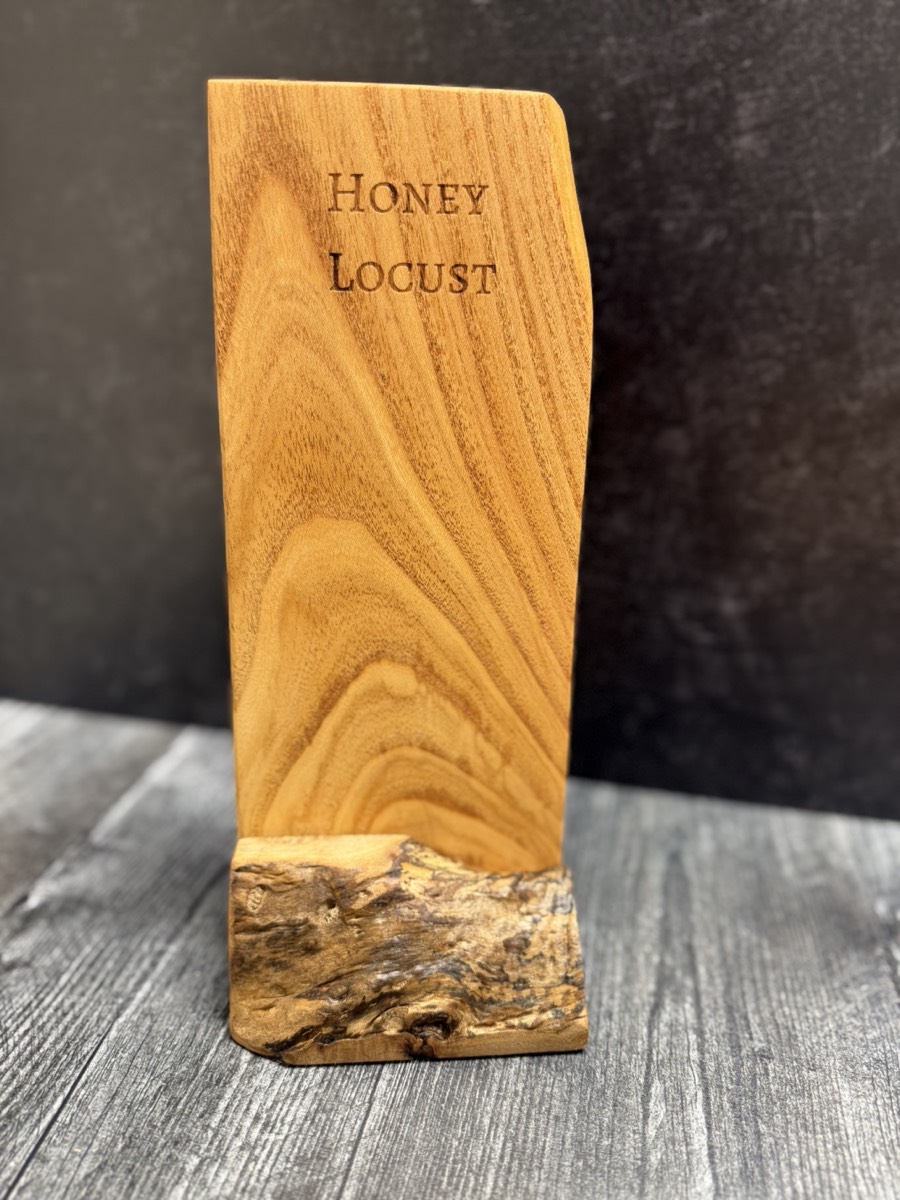
Honey Locust specimen — Gleditsia triacanthos
DomesticGleditsia triacanthos

Honey Locust

Dramatically underused for what it is.

Honey Locust (Gleditsia triacanthos) is a domestic hardwood with a Janka hardness of 1580 lbf. Its heartwood is medium reddish brown, sometimes streaked with red, orange, or coffee, set against wide pale yellow sapwood, and it fluoresces under blacklight.

Category
Domestic
Janka
1,580 lbf
Botanical
Gleditsia triacanthos
Shipped at
6–8% MC

Gleditsia triacanthos Native range centered in the central United States from southern Pennsylvania west to Iowa and south to eastern Texas and the Gulf Coast; widely planted as an ornamental and naturalized well beyond its native range

Native range centered in the central United States from southern Pennsylvania west to Iowa and south to eastern Texas and the Gulf Coast; widely planted as an ornamental and naturalized well beyond its native range.

Gets confused with black locust constantly. Heartwood medium reddish brown, sometimes streaked with red, orange, or coffee.

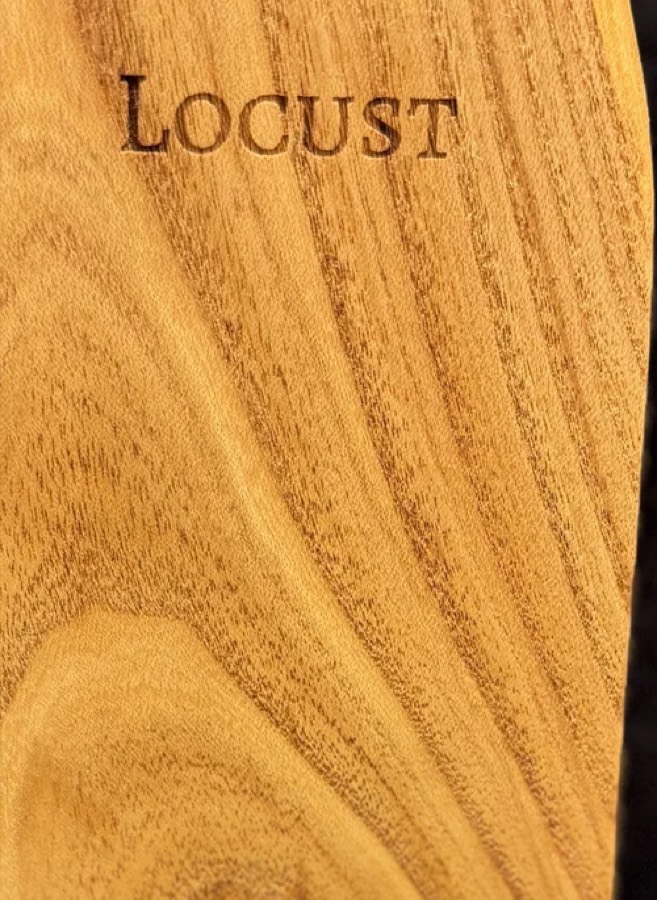
Detail of Honey Locust grain — figured wood texture, photographed at Raw Heartwood
A close read on the grain. Detail of this specimen

What you see.

Heartwood medium reddish brown, sometimes streaked with red, orange, or coffee. Wide pale yellow sapwood, hard contrast. The wood fluoresces under blacklight — handy for telling it apart from look-alikes.

Heartwood color detail of Honey Locust (Gleditsia triacanthos)

Heartwood, this specimen

How the grain runs.

Mostly straight, sometimes slightly irregular. Medium uneven texture. Coarse open ring-porous structure. Moderate luster.

Closer detail of Honey Locust grain figure

Closer in

On the bench.

Heartwood durable to very durable in ground contact. Insect resistance is good but not black-locust good. Sapwood is non-durable. Hard and dense, but cooperative with sharp tooling. Glues, turns, finishes well. Takes a high polish. Pre-drill for nails and screws. Mild to noticeable at the cut. Some say it smells like clover honey once it is seasoned. Maybe. Standard dust precautions. No specific reactions reported. The lookalike — black locust — is a documented sensitizer. This one is not.

The numbers, looked at directly.

Janka Hardness

0lbf

7,030 N. Side-hardness — force to embed a half-inch steel ball halfway into the wood.

Average Dried Weight

0lbs/ft³

675 kg/m³. At 12% MC.

Specific Gravity

0.60/ 0.66 at 12% MC

Basic over green volume; second number at 12% moisture content.

Hardness, in context
Pine 380 Cherry 950 Red Oak 1,220 H. Maple 1,450 Hickory 1,820 Jatoba 2,350 honey locust

A side-hardness measurement. Higher number, harder wood.

Shrinkage — radial / tangential / volumetric
4.2%radial
6.6%tangential
10.8%volumetric

On sourcing

Where this wood comes from matters.

Not on CITES. IUCN Least Concern. Common in cultivation. Plenty of urban-removal salvage and small-scale specialty supply.

What it's for.

Worth knowing.

Gets confused with black locust constantly. Not the same tree. Honey locust has compound leaves with smaller leaflets, foot-long seed pods, and branched trunk thorns on wild stock. Most landscape trees are the thornless cultivar. Underused for what it is.

Sources & references.

  1. Wood Handbook — Wood as an Engineering Material (FPL-GTR-282) — USDA Forest Service, Forest Products Laboratory (2021)
  2. Silvics of North America: Gleditsia triacanthos L. — Honeylocust — Blair, Robert M. (USDA Forest Service) (1990)
  3. Gleditsia triacanthos — IUCN Red List of Threatened Species — Stritch, L.; Barstow, M. (2019)
  4. Gleditsia triacanthos — Wikipedia contributors
  5. Honey Locust (Gleditsia triacanthos) — The Wood Database
  6. Gleditsia triacanthos — Fire Effects Information System (FEIS) — Sullivan, Janet (USDA Forest Service, Rocky Mountain Research Station) (1994)

Common questions.

How hard is Honey Locust wood?
Honey Locust has a Janka hardness of 1580 lbf, making it a hard, dense domestic hardwood. That USDA Forest Products Laboratory value is measured at 12% moisture content, while Raw Heartwood kiln-dries its lumber to 6-8% moisture content.
Is Honey Locust good for outdoor use?
Its heartwood is durable to very durable in ground contact, which is why it has long been used for fence posts and railroad ties. Insect resistance is good but not as strong as black locust, and the pale sapwood is non-durable, so it should be excluded from outdoor work.
What is Honey Locust used for and where does Raw Heartwood's come from?
It works well for furniture, flooring, turnings, tool handles, fence posts, railroad ties, and pallets, gluing, turning, and finishing well and taking a high polish. Raw Heartwood sources its Honey Locust as urban-removal salvage from the Chicago area.

From the library to your bench

We mill, dry & sell Honey Locust in West Chicago.

Tell us what you're building and we'll cut to order.

Request a slab or a cut →